Mission: AstroAccess
Making Space Travel Inclusive for All
UC San Diego researchers participate in zero gravity flight to understand ability, disability in space
By Kiran Kumar
In a weightless, microgravity environment like space, what do ability and disability look like? How can someone with partial sight or impaired mobility navigate in a confined space like the space station? As scientists and innovators continue to push the boundaries of spaceflight and the possibility of human life on other planets, how can we build space infrastructure that is inclusive of all humans?
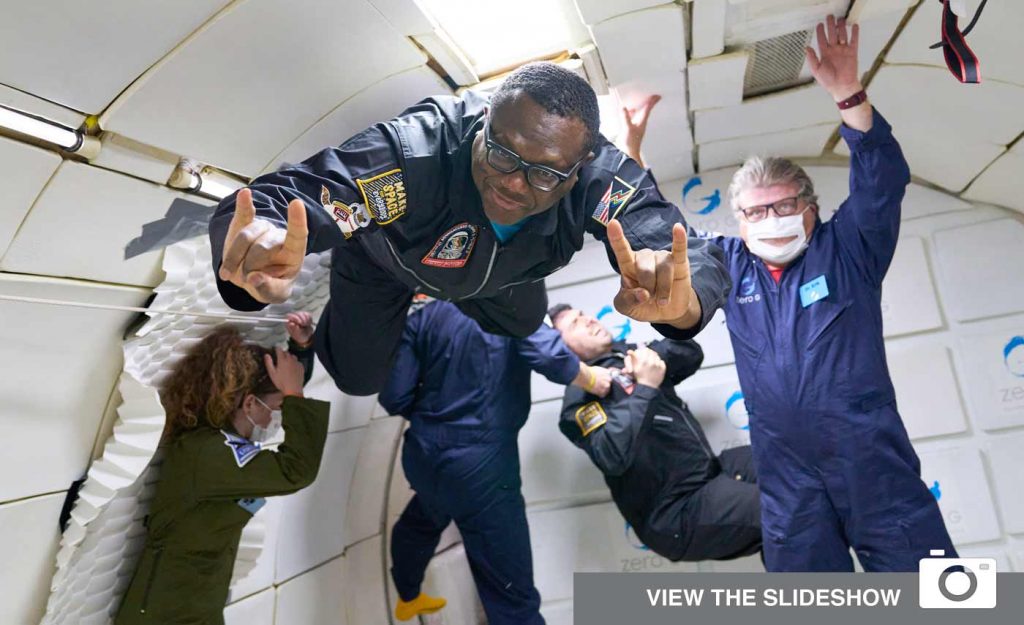
The Mission: AstroAccess project aims to answer these questions, starting with a historic parabolic flight that took off from Long Beach on Oct. 17, 2021. A group of 12 disabled scientists, veterans, students, athletes and artists launched into a zero-gravity environment as a first step toward understanding what is needed to make space inclusive for all.
“The whole point of this project is to demonstrate that people with disabilities are able to fly safely into space,” said Dr. Erik Viirre, director of The Arthur C. Clarke Center for Human Imagination at the University of California San Diego, and a neurologist at UC San Diego Health. Viirre served as medical and flight operations lead for the AstroAccess flight, ensuring a safe environment for all 12 AstroAccess Ambassadors and their partners on board. “What we’re working on in this initial flight are demonstrations of a variety of different tasks that our Ambassadors will have to carry out, including navigating up, down, left and right; clear communication; and being able to move to a set location.”
In addition to Viirre, aerospace engineering student Brenda Williamson, the former president of the UC San Diego chapter of the American Institute of Aeronautics and Astronautics (AIAA), served as head of the logistics committee in preparation for the flight.